
By Georgina Maka’a
Prime Minister promises lower power costs, support for local businesses, and an economy that works for all Solomon Islanders
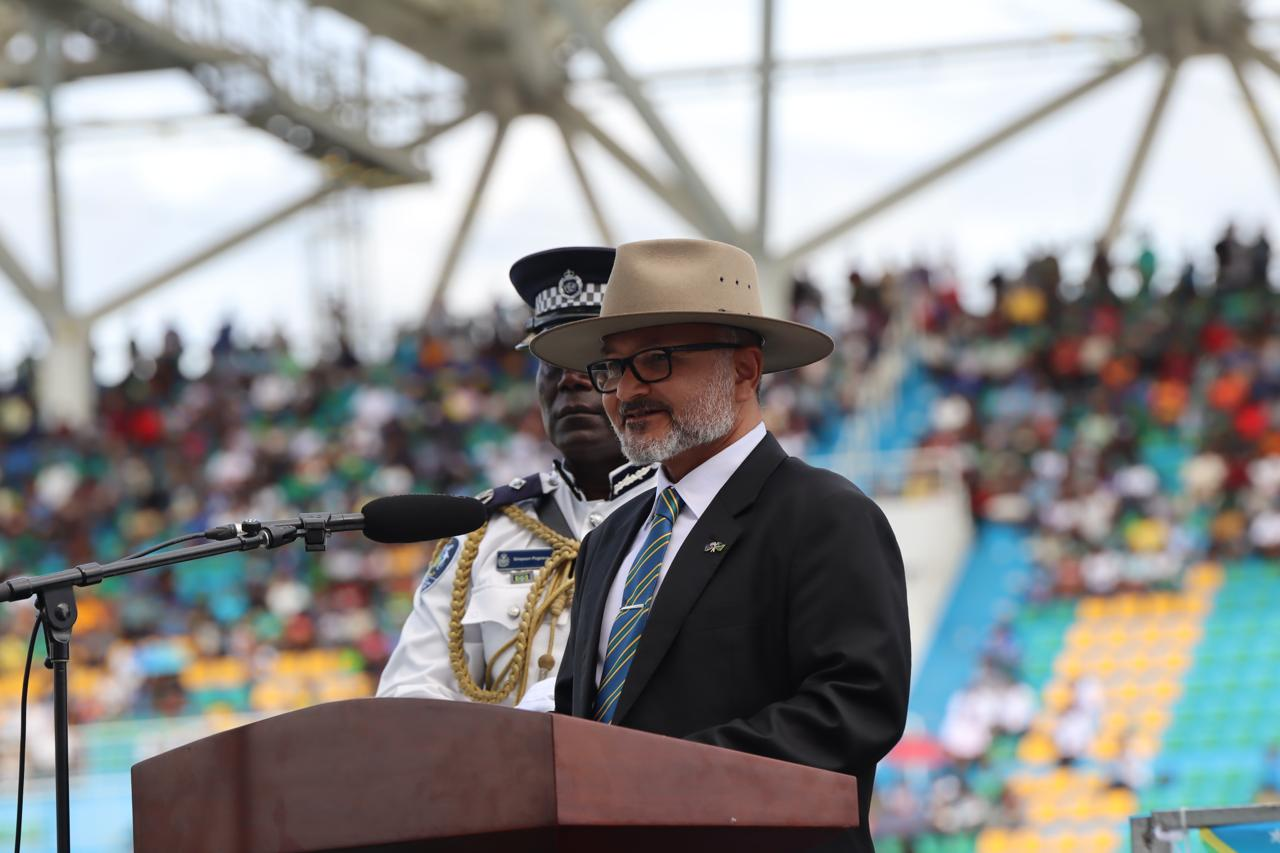
Prime Minister Matthew Wale used this morning’s 48th Independence Day celebrations in Honiara to deliver a clear message economic growth that only benefits the capital is not enough.
Speaking to a packed stadium at the national ceremony, Wale said his government’s vision for economic transformation is built on one principle: every Solomon Islander must have a real stake in the nation’s future.


“Economic transformation is not merely about increasing national income,” he said. “It is about creating opportunities that allow our own people to participate fully in building the future of their own nation. It is about ensuring that prosperity reaches villages as well as towns. Provinces as well as the capital. Women as well as men. Young people as well as established businesses.”
The Prime Minister acknowledged the financial strain families across the country are dealing with every week. Rising electricity costs, transport fares, and the price of essential goods, he said, are placing real pressure on households.
“These are not abstract economic statistics,” Wale said. “They affect real families. Real communities. Real lives.”
Wale singled out the high cost of electricity as one of the biggest barriers to development, calling affordable energy a necessity rather than a luxury. Without it, businesses struggle to grow, manufacturers cannot compete, and young entrepreneurs cannot get started.
He said his government is committed to bringing down electricity costs through strategic investment and reform. Lower energy prices, he argued, would do more than ease household expenses.
“Lower energy costs will not simply reduce household expenses,” Wale said. “They will unlock investment. Create employment. Expand opportunity. And strengthen national competitiveness.”
The Prime Minister also said farmers, fishers, tradespeople, artisans, small business owners, and young innovators need opportunity, not handouts.
“Government has a responsibility to create an environment where indigenous enterprise can flourish,” he said. “Not by replacing private initiative. But by enabling it.”
He said when local businesses grow, local families benefit. When they expand, employment rises. When they invest, communities get stronger.
“The prosperity of Solomon Islands will ultimately be built not only by government expenditure,” Wale said, “but by the creativity, industry and resilience of its people.”
