
By Georgina Maka’a
ANTALYA, Türkiye
Solomon Islands has challenged global leaders at COP31 to ensure international climate finance flows directly to vulnerable villages and informal urban settlements, rather than remaining bottlenecked in national capitals.
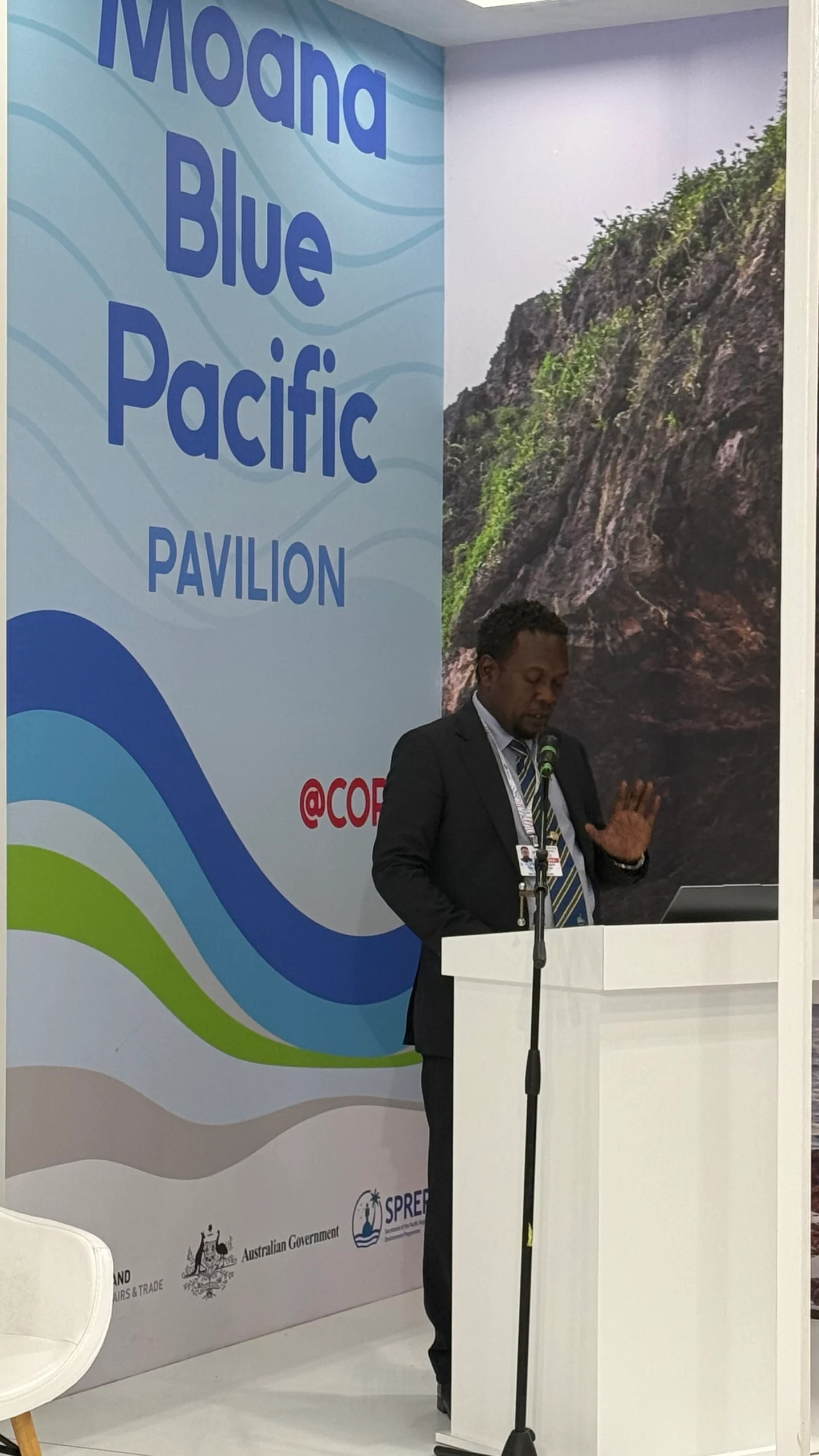
Speaking at the opening of a COP31 side event titled Scaling Pacific Resilience: Solomon Islands Adaptation in Action, Communities to Cities, Minister for Environment, Climate Change, Disaster Management and Meteorology Wayne Ghemu said lasting climate adaptation must be built from the ground up, linking grassroots community action with urban infrastructure.
“We are not here to ask for sympathy,” Minister Ghemu told delegates, development partners, and youth representatives in Antalya. “We are acting at home, and our lesson is simple: resilience is strongest when it is built from the ground up.”
To ground the urgency of the Pacific’s climate crisis in lived experience, the minister pointed back to the devastating April 2014 Honiara floods, when days of relentless rain caused the Mataniko River to burst its banks.
“Within hours, homes and bridges were swept away. More than twenty people died. Thousands lost everything, many of them living along the river, where our growing city had pushed them,” Ghemu stated.
He noted that the disaster inflicted massive economic harm, recalling that “the flood caused US$107.8 million in damage and loss, about 9.2 percent of our GDP.” He warned that such catastrophic events are no longer distant projections but a recurring reality for the region.
Rather than treating rural and urban challenges in isolation, Minister Ghemu said Solomon Islands is weaving local and national initiatives into a single “resilience pathway.” He highlighted two flagship programs driving this approach on the ground:
- The SOLKAS Project: Funded by the Green Climate Fund (GCF) in partnership with Save the Children, the initiative equips schools, women, youth, faith groups, and community leaders to assess local climate risks and craft solutions rooted in traditional knowledge.
- CAUSE II: Backed by the World Bank, the project strengthens climate-resilient infrastructure and essential public services across Solomon Islands’ rapidly expanding urban centers.
Minister Ghemu also pushed back against framing children and young people solely as victims of climate disruption.
While acknowledging that extreme weather frequently interrupts schooling and cuts off access to clean water and healthcare, he emphasized that youth are active innovators and advocates within their communities.
He added, “Investing in climate-resilient schools and giving young people a seat in adaptation planning, he stated, protects the next generation while strengthening entire communities today.
True resilience, the minister added, demands inclusivity, ensuring that women, people with disabilities, and the country’s most marginalized settlements are directly involved in decision-making rather than left behind.
Challenging international partners to move beyond piecemeal, short-term projects, Minister Ghemu called for connected systems that link villages to provincial governments, provinces to urban planners, and cities to national policy and finance frameworks.
Standing in solidarity with the Alliance of Small Island States (AOSIS) and the broader Pacific family, the Minister laid out three non-negotiable demands for the Antalya summit: keep the 1.5°C warming threshold within reach, fund adaptation at the true scale of need, and guarantee that climate finance reaches the frontlines from remote villages to riverbank settlements.
“With AOSIS and our Pacific family, Solomon Islands says, ‘This COP must deliver,'” Minister Ghemu concluded.
