
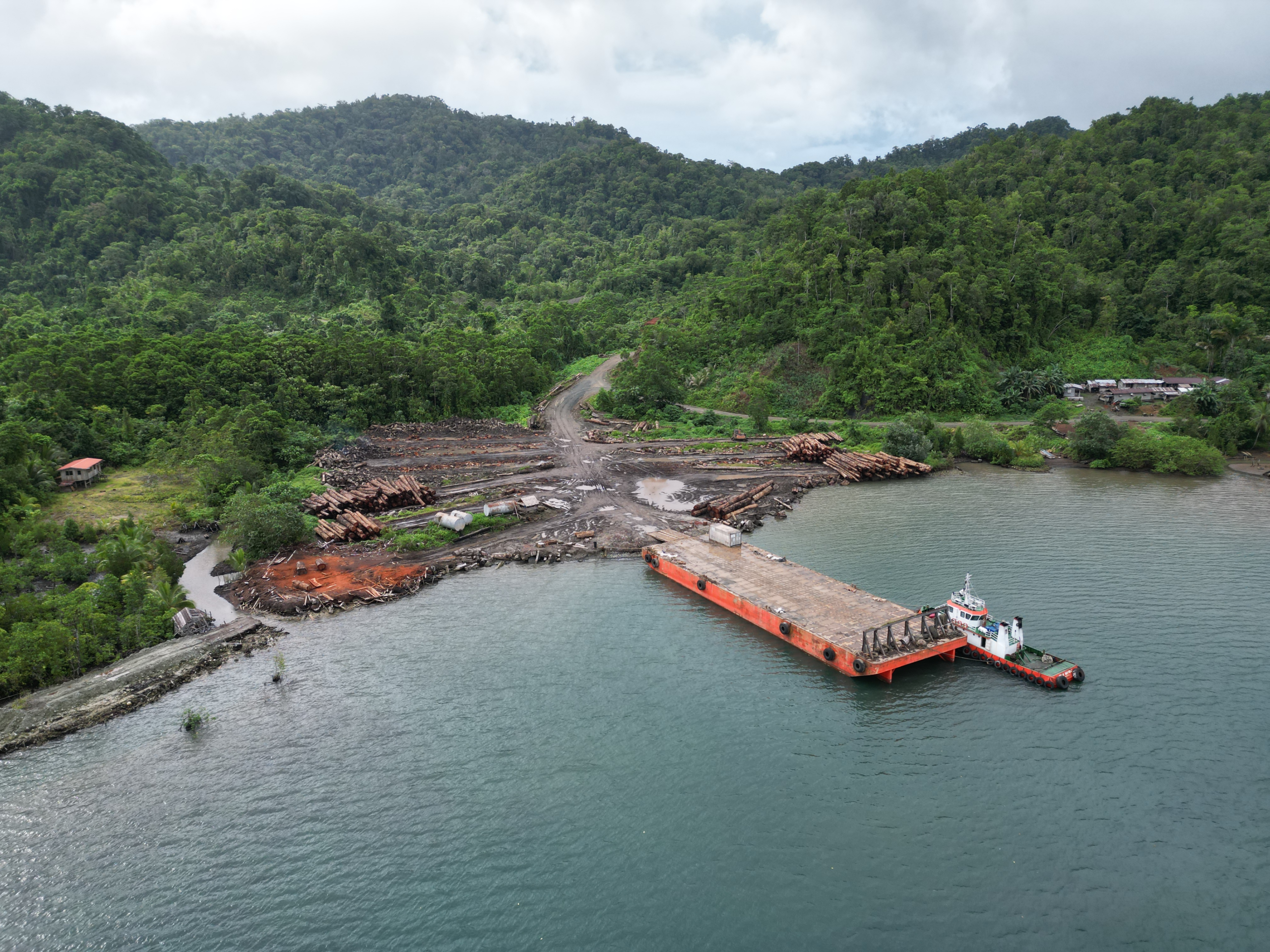
For decades, the sound of chainsaws and heavy machinery have been a normal part of life in the rural Solomon Islands.
The country’s rich, dense rainforests have been cut down, piled onto ships, and sent overseas, normally to China as the final destination.
But in the last two years, the nation faces a hard truth – its natural production forests are almost completely gone.
Now, the government and local communities are in a race against time.
They are trying to change how they use their land before the very last commercial trees disappear.
For a long time, environmental experts warned that trees were being cut down much faster than they could grow back.
According to data from the Global Forest Watch dashboard for the Solomon Islands, the country lost 250,000 hectares of tree cover between 2001 and 2025. That is equal to about a 9% drop in forest cover since the start of the century, with 65% of the loss happening in untouched primary forests.

Historical reports by the Food and Agriculture Organization (FAO) showed that while the country’s safe, sustainable harvest level was set at 200,000 cubic meters of wood per year, actual logging levels often went past 1 million cubic meters.
Forests at critical breaking point
Gideon Solo, the deputy Commissioner of Forestry and Head of the Forest Management and Technical Services Division at the Ministry of Forestry and Research, confirms that the country has reached a critical breaking point.
“Over the past two years we’ve seen a noticeable decline in logging activity,” Solo states.
“Log exports have decreased, fewer logging licences are operating, and production has dropped significantly.
According to Solo, the days of finding untouched lowland forests are over.
“Many commercially accessible forests have already been harvested,” he explains.
“As a result, much of today’s logging consists of second-entry or even third-entry logging in previously harvested areas rather than opening new forests.”
Historically, about 22 percent of the Solomon Islands’ forests were classified for production.
Today, Solo warns that most of those accessible forests – particularly those below 400 meters elevation – have been heavily depleted, leaving “only a very small proportion” of commercial wood left.
The Financial Dependency and the Unfair Split
It is easy to wonder why logging was allowed to continue for so long when it was so unsustainable.
The answer is simple: money.
Data cited by In-depth Solomons shows just how much the country relies on timber.
The industry brings in 20% of all government revenue, makes up 60% of all export earnings, and employs around 10,000 people.
However, the financial rewards have never been shared equally.
Solo explains that the typical arrangement is an approximate 60–40 split.
“Typically, around 60 percent goes to the logging company or operator,” Solo says, “while the remaining share is divided between local landowners and the government through royalties and taxes”.
Even worse, the country has likely been shortchanged for decades due to poor oversight.
“Monitoring is one of the biggest challenges,” Solo admits.
“If monitoring only captures a small proportion of logging activities, the Government cannot collect the full amount of revenue it should receive.”
He notes that weaknesses in the regulatory systems have likely resulted in “substantial revenue losses over time.”
To fix this, Solo argues that the country needs a proper “chain-of-custody” system to track timber from the forest floor to the final consumer.
“Without comprehensive monitoring, Solomon Islands risks losing significant revenue because the Government cannot accurately verify production volumes and exported timber,” he warns.
Shadows in the Forest: Illegal Logging and Broken Promises
The exhaustion of the forests has also brought an increase in illegal activities and environmental breakdown.
The Ministry currently monitors active operations to ensure companies follow environmental rules, but their reach is limited.
“Illegal logging remains a significant concern,” Solo notes.
He points out that these activities happen in several ways, including “operating without valid licences, illegal movement of logs, or exporting timber that has not been properly documented.”
When caught, the government can suspend licenses or stop shipments, but gathering enough court-ready evidence remains difficult.
Meanwhile, the land itself is failing to recover.

While logging licenses legally require companies to replant trees after harvesting, the reality on the ground is very different.
“There is often a gap between what the law requires and what happens in practice,” Solo says.
“Limited resources and weak enforcement have made it difficult to ensure companies fully comply with their reforestation obligations.”
In many cases, loggers make private deals with landowners that ignore replanting entirely, leaving the local communities with long-term soil erosion and ruined water supplies.
The Turning Point: Value-Adding and Carbon Trading
With the timber resources vanishing, the old model of raw log extraction is no longer viable. In response, the government has launched major policy shifts in 2026 to save the economy and protect the remaining environment.
First, the government introduced the Downstream Processing and Value-Adding Policy.
This rule forces companies to stop exporting raw round logs and instead invest in local sawmills and factories to create finished wood products.
This keeps more money and jobs inside the country.
Second, the Ministry is looking to the skies to protect what is left by creating a National Carbon Trading Policy.

Rather than cutting down trees for a one-time payout, landowners will be paid by global buyers to keep their forests standing.
“That policy will provide the framework needed to regulate carbon trading in Solomon Islands,” Solo explains.
While some communities are already joining voluntary carbon markets on their own, Solo says the government’s goal is to create proper regulations “so carbon trading is properly managed and communities benefit fairly.”
The Solomon Islands is at a critical moment.
The era of unchecked logging is ending, not by choice, but because the trees are gone.
The success of these new reforms will decide whether the country can heal its scarred land and build a sustainable, green economy for the future.
by Ronald Toito’ona _ Ronald is no longer working with In-depth Solomons.
This story was produced with funding support from PACMAS (Pacific Media Assistance Scheme), an Australian Government aid program designed to strengthen and support a diverse, independent and professional media sector across the Pacific.

You must be logged in to post a comment.