
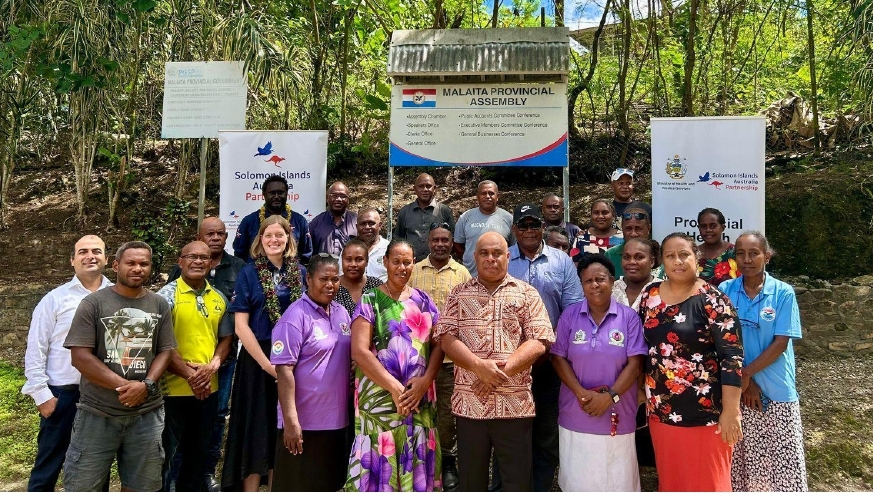
Rosely Akomu had never been to a health summit before. Not once, in all her years as Provincial Minister for Health.
So when she walked into the room in Auki last week and found herself surrounded by women leaders, village elders, church pastors, and young people from across Malaita, she paid close attention.
“This has given me important insights into the realities of our health system,” she said. “Especially the need to strengthen Primary Health Care and revitalise the Provincial Health Council.”
For five days, from 18 to 22 May, the Ministry of Health and Medical Services — backed by Australia — brought together a cross-section of Malaita that doesn’t often share the same room. Women representatives. Religious leaders. Provincial officials. Health workers. NGO staff. Community leaders. The brief: talk about what’s broken in local health care, and figure out what to do about it.
Dr David Danitofea, Malaita’s Provincial Health Director, didn’t sugarcoat it.
“Malaita Province’s health priorities and challenges cannot be solved by the health services alone,” he said. “Government departments, donors, development partners, religious leaders, women leaders, youth, businesses and communities must work together. Individuals also have a responsibility to look after their own health and wellbeing.”
Participants worked through Root Cause Analysis and Plan–Do–Study–Act cycles — tools that sound technical but turned out to be surprisingly practical.
By the end of the week, they had built a Provincial Health Scorecard, mapped out the biggest gaps in the system, and come up with action plans they actually owned.
However speaking at the opening of the summit Malaita Province Premier Elijah Asilaua said health remains a fundamental pillar of development.
“Without a healthy population we cannot achieve sustainable economic growth, quality education, or resilient communities.” he said.
He thanked Australia and the national government for their backing, but directed his sharpest words toward local communities.
“Through Ward Development Committees, our people can actively participate in shaping and strengthening health services,” he said.
Australian High Commissioner Jeff Roach said the structure of the summit was deliberate.
“Bringing provincial leaders, health workers and communities together like this ensures solutions are grounded in local realities,” he said.
“By working together, with local voices leading the way, we can identify practical solutions that are inclusive and sustainable.”
The phrase that kept coming up throughout the week was Tok Stori, Lokol Voisis, Lokol Solusons — talk story, listen to local voices, find local solutions. It sounds simple. But for a province where health services are stretched thin and distances are long, the approach marks a real shift in how things get done.
