
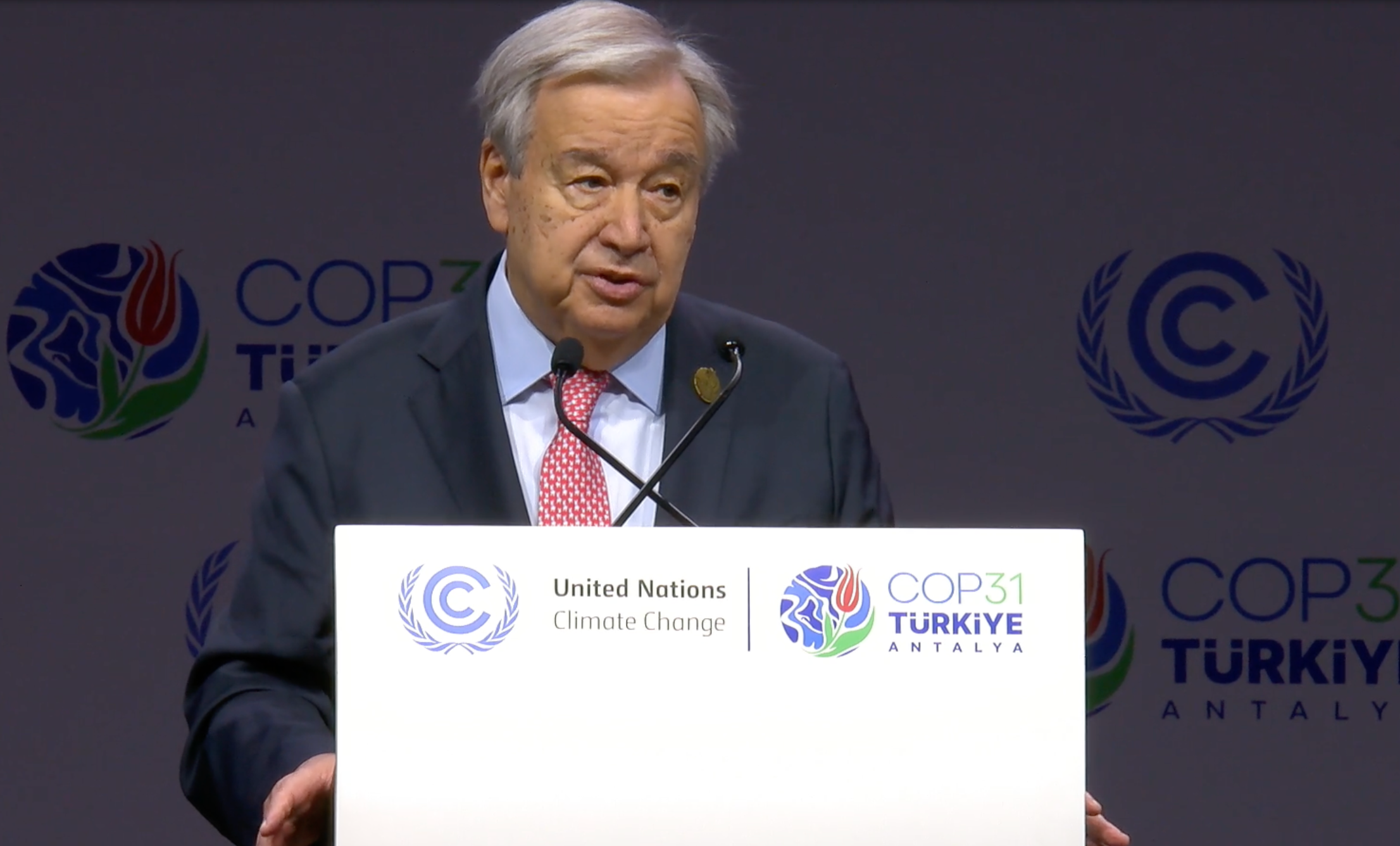
by Charley Piringi in Antalya, Turkiye
UN Secretary-General António Guterres delivered a sobering opening address at the COP31 climate summit, delivering a powerful warning that humanity is on a path to “mutually assured destruction” as climate-fueled disasters intensify across the globe, with low-lying Pacific Island nations positioned directly on the frontlines.
Speaking to world leaders and delegates, Guterres said that despite the Paris Agreement’s pledge to limit global temperature rise to 1.5 degrees Celsius, science confirms an overshoot is now inevitable.
However, he added that world leaders hold the power to determine the duration and severity of the crisis.
“Our first climate duty is to tell the truth, and the brutal truth is that the climate crisis is outrunning us,” Guterres declared. “Emissions in 2025 reached all-time highs. Its records keep shattering… Climate disasters are pounding lives, livelihoods, and economies across the globe, and this is the path to mutually assured destruction.”
Addressing the severe inequities in global climate response, Guterres said climate justice is the defining challenge of the upcoming decade. He highlighted that emerging and developing economies outside China account for nearly two-thirds of humanity, yet receive less than one-fifth of global clean energy investment.
“We cannot demand that countries transform their economies while denying them the means to do so,” he urged, calling for a new Climate Justice Compact. “Developed countries must live on delivering at least 300 billion US dollars a year by 2035, and set out concrete plans with clear milestones to at least triple adaptation finance by then.”
The call for urgent support resonates strongly with leaders representing vulnerable Pacific communities.
Australian Prime Minister Anthony Albanese reinforced the existential crisis facing Pacific neighbours, sharing the story of Mella Lucy Sokatea, a 13-year-old student from Tuvalu who pleaded for international action to protect her homeland.
“We all have one simple dream: to grow up safely here in Tuvalu, the place we call home. We are not asking for pity. We are asking for help and partnership,”
Albanese quoted from the young Tuvaluan’s message. He noted that Tuvalu’s islands stand an average of just 1.83 meters above sea level, making rising sea levels an immediate existential threat.
Albanese urged developed nations to back regional initiatives like the Pacific Resilience Facility, the first Pacific-led regional climate financing mechanism—to ensure small island nations do not face rising seas and storm surges alone.
Guterres concluded with a firm stance on accountability, demanding that major fossil fuel corporations—which pocketed $95 billion in profits in just one quarter—help foot the bill for climate damages.
“And those who profit most from fossil fuels must help foot the bill for the damage they have caused. In the last quarter alone, the nine largest oil companies pocketed $95 billion in profits.
It is time for governments to tax these windfall profits and use them to help vulnerable countries recover. Polluters must pay,” he said.”
This story was produced as part of the COP31 Climate Change Media Partnership, a journalism fellowship organized by Internews’ Earth Journalism Network, Informed Earth and the Stanley Center for Peace and Security.
