
By Rex Ramo
-
Introduction.
On 19th December 2025 Cabinet discussed the Joint Cabinet paper on the Policy Direction and Regulatory Options for sufferance Wharves and Leroy Port Operations. The paper was based on the Special Committees Report on the use of Sufferance Wharves, as Cabinet approved on 3rd June 2025.
On 6th January 2026, the Ministers of Finance and MID then wrote to the Comptroller of Customs (copied to both SIPA, SIMA and Leroy Wharf owners) and conveyed Cabinets decision.
The purpose of this note is to discuss Cabinet’s decision and identify possible loopholes in the recommendations and propose necessary policy actions to further strengthen Cabinets directives on 19th December 2025.
2.0 Cabinets Decisions.
Cabinet had approved the following policy options.
2.1 Normalization of Leroy Wharf Operations.
Under this option, Cabinet had approved that;
(a) Leroy Wharf operations will be brought under the Ports Act, with SIPA assuming both harbor master and pilotage authority over Leroy Wharf;
(b) SIPA to collect statutory dues,
(c) Leroy Wharf as a private licensed port to come under the SIPA supervision, and (d) The Minister of Finance and Treasury to direct both SIPA and Solfish Company Ltd to meet and ensure Leroy Wharf International Port adheres to the Ports Act.
This policy action was crucial in light of the closure of one of SIPA’s berth due to construction works and the traffic congestions associated with the road construction along the Point Cruz highway. It was also recommended that some imported cargoes would also be barged to Leroy Wharf for collection as only SIPA and Leroy Wharf are ISPS compliant international sea ports in the country.
2.2 Legislative Reforms.
Under this option, the Ports Act would be amended to create the statutory framework to allow privately owned and operated ports be subject to strict regulatory conditions. This means a substantial policy shift that would require further formal Cabinet approval and Parliament enactment.
This option was also vital especially in preparation for other national projects like the Bina Harbour Project and the construction of Special Economic Zones. The Legislative reforms are also needed for attracting foreign investments in the country.
2.3 Closure of Sufferance Wharves.
Cabinet also agreed to close all existing sufferance wharves nationwide, and retain only declared ports that are lawfully administered under the Ports Act (Cab.161). This policy option requires strict enforcement action by Customs Division, SIPA, SIMA and other relevant government border agencies to withdraw, suspend or decline renewal of sufferance wharf licenses, except in narrowly defined and exceptional circumstance where temporary approval is necessary and legally justified.
This policy option was necessary to restore clarity, consistency, and integrity to the national port’s framework, by eliminating the structural reliance on sufferance wharves that have, over time, allowed quasi-port operations to develop outside statutory port governance. The closure of sufferance wharves was also necessary to ensure all international cargo movements are channeled through declared ports that are subject to full SIPA control, uniform pilotage, with consistent security standards as required under the ISPS code, and proper collection of statutory port dues.
Implementing this policy option would be policy-driven rather than discretionary, and would require Cabinets formal approval to guide Customs administration nationwide. However, Cabinet reasoned that under this option, the Comptroller of Customs will retain independent statutory authority under the Customs Act (Cab 121) regarding the granting or refusal of individual sufferance wharf licenses. As a result, Cabinet had approved the closure of all sufferance wharves in the country, as a policy direction, to avoid the unlawful fettering of the Comptrollers discretion under the Customs Act.
It was noted that adopting this policy option would have significant practical and economic implications, including increased pressure on existing port infrastructure, potential short-term disruptions to specialized cargo operations (such as oversized project cargo or bulk break cargo), and the need for capacity expansion at SIPA controlled ports. In the long term, the policy option would also strengthen port safety oversight, elimination of revenue leakages, improved security compliance, reduce regulatory fragmentation, and restoration of a single, coherent national port governance in line with the Ports Act (Cab.161).
2.3.1 Importance of ISPS Code compliance.
The decision to close all sufferance wharves was also necessary to ensure full compliance with the security maritime international standards and networks, particularly under the SOLAS Convention (safety of Life at Sea Convention) and the International Ship and Port Facility Security Code (ISPS). As the Director of Solomon Islands Maritime Authority (SIMA) reported during his presentation before the Bills and Legislation Committee recently, the “authority’s mandate is to strengthen maritime security in Solomon Islands, particularly at port facilities handling international cargoes”. ISPS code strict compliance was mandatory under the international maritime law and is essential to maintaining international trade access and confidence. As Mr. Thierry Nerval (Director of SIMA) had said, “maintaining international maritime security standards is critical to protecting Solomon Islands borders and maintaining trust with global trading partners”.
Mr. Nerval also reported that industrial cargo operations at sufferance wharves had also increased in recent years. While this is consistent with the development needs of the country, the continued lack of none compliance with SIMA reporting requirements of unloading and storage of imported cargoes at sufferance wharves remain a major concern that demands full investigation by responsible authorities. As Director of SIMA, Mr. Nerval was absolutely correct in raising the need to further strengthen port facility security and improve national coordination between responsible government agencies and stakeholders.
2.3.2 Goodwood and Penquin Sufferance Wharves are not ISPS compliant.
Available information had confirmed that owners of both Goodwood and Penquin sufferance wharves do not comply with the ISPS code. This is a great concern as their continued use and operations risk Solomon Islands international trade. Cabinet’s decision to close sufferance wharves was therefore relevant, as both sufferance wharves are not ISPS complaint. The information also showed that only Solfish Company Ltd that owns and operates Leroy International Wharf has fully complied with the ISPS code. The latest SIMA certification of Leroy’s compliance with the ISPS code was done in December 2025. SIMA had confirmed that annual ISPS compliance audits were also done on Leroy port facilities.
Mr. Philippe Thieu also appeared on behalf of Ellite Enterprises Ltd (owner of Penquin sufferance wharf) before the Bills and Legislation Committee during its inquiry on the Dangerous Drugs Amendment Bill 2025. He confirmed that Penquin sufferance wharf had recently facilitated the unloading of imported cargoes for Gold Ridge Mining Ltd as SIPA wharf is far from the mine site. The Gold Ridge cargoes arrived on MV Vandon Sea (IMO 9217814) on 27th February 2026, discharged its cargoes at Penquin sufferance wharf and left on 2nd March 2026. Available informations have now confirmed that there was no declaration of security (DOS) done between the ship Security Officer (SSO) and the Port Facility Security Officer (PFSO) as required under Part A, Section 5 of the ISPS Code. This was a clear violation of the ISPS code core requirements, and a blatant disregard of Cabinets decision to close all sufferance wharves, as relayed to Comptroller of Customs on 6th January 2026.
Furthermore, Mr. Thieu’s stated that Penquin sufferance wharf is operating with full approval from both the Guadalcanal Provincial Government and SIMA. This was totally incorrect. The fact is that the Guadalcanal Provincial Government Planning Board had neither approved the construction of Penquin sufferance wharf, nor issued a business license to operate the sufferance wharf.
On 23rd September 2025, Hon. Premier William Atu, of Guadalcanal Province issued a public statement on the sufferance wharf issue and said that;
“the Guadalcanal Provincial Government (GPG) has issued an urgent statement condemning any ongoing potential illegal operations of sufferance wharves within its jurisdiction, especially from Poha Rive in the west to Metapona Rive in the east. Originally intended solely for export under the Customs and Exercise Act, these wharves have however morphied into Centre’s for potential unregulated imports and illicit business activities. Their continued without permission, valid business licenses, and formal land acquisition under the Lands and Titles Act represents a direct violation of the rule of law and poses a significant threat to our society. This evolution is fueled by vested interests as reported in the media, poor enforcement and policy neglect, escalating the issue beyond administrative concerns to one involving public safety, indigenous land rights, and environmental protection”.
The Hon. Premier also said that;
“Many businesses operating at these wharves lack valid licenses or approval from the Guadalcanal Provincial Planning and development Board, rendering their activities already illegal and unregulated”.
2.3.3 Operators of sufferance wharves raised no comments on proposed amendments.
The Bills and Legislation Committee appreciated Mr. Thieu’s presentation at the inquiry into the Dangerous Drugs Amendment Bill 2025. However, his presentation lacked substance. The Dangerous Drugs Amendment Bill (2025) focuses on raising penalties for serious drug offences, particularly methamphetamine trafficking, which is highly relevant and urgently needed now given the recent drug interceptions, arrests of foreign nationals, and metha-related incidents in Solomon Islands waters that threatens the security of legitimate ports and safety of international maritime trade.
Unlike Leroy Wharf International Port’s strong support for the proposed amendments to the Dangerous Drugs Bill (2025), Mr. Thieu had failed to comment on the amendments to Clauses 4 to Section 39 of the Dangerous Drugs Act (Cap.98), which introduces imprisonment and substantial fines (or both) for major trafficking offences.
3.0 Unloading of imported cargoes at sufferance wharves defied Cabinets decision.
Despite Cabinets decision to close all sufferance wharves in the country on 19th December 2025, unloading of imported cargoes continued unabated at both Goodwood and Penquin sufferance since January 2026.


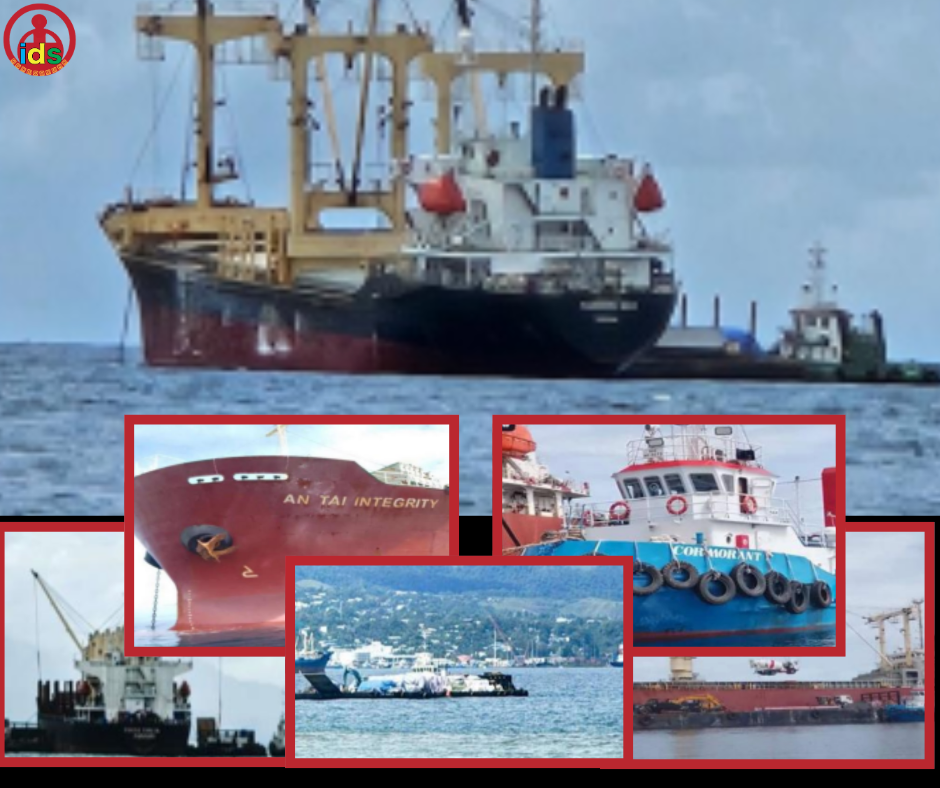
The first incident occurred on 9th January 2026 when a Panamian flag ship (MV An Tai Integrity, IMO 9244312) entered Leroy Wharf port facility sea coordinated area without authorization and discharged cargoes at Penquin sufferance wharf. The vessel had bypassed standard entry protocols, and unexpectedly entered the Leroy Wharf sea coordinated area without advance notice or clearance.
Informations about the vessel never reached the upper management of the ISPS team. This lapse of protocol created potential threat to port safety and security, although the unloading operation concluded without any injuries or environmental harm.


The second incident occurred on 29th January 2026 when MV Trans Thalia arrived in Honiara and discharged its imported cargoes at Goodwood sufferance wharf, despite none compliance to the ISPS code and Cabinets decision.


The third was the unloading of Gold Ridge Company imported cargoes at Penquin sufferance wharf as Mr. Thieu reported to the Bills and Legislation Committee. The above three incidents showed total defiance of Cabinets decision to close all sufferance wharves, and lack of thorough monitoring and adherence to Cabinet decisions by responsible agents and governments authorities.


Reliable sources within the Customs and Exercise Division, Ministry of Finance and Treasury confirmed that two foreign ships are also destined to arrive this week, starting 20th April 2026. Both ships will unload their cargoes at both Goodwood and Penquin sufferance wharves.
The first ship (Sea Adelaide) is scheduled to arrive on 21st April 2026 and discharge its cargoes at Goodwood sufferance wharf. The cargo manifest shows that the consignees are TBC hardware, CCECC, Goodridge and Solomon Nickel Company.
The second ship (Royal 1) is schedule to arrive on 23rd April 2026 and unload its imported cargoes for Goldridge mining project at Penquin sufferance wharf. The acting comptroller of customs declined to respond when asked about the two shipments and continued unloading at both sufferance wharves contrary to Cabinets decision to close such wharves in late 2025.
4.0 Non-Compliance with SI laws.
While Cabinets decision was consistent with GNUTs policy of enhancing revenue collection to fund its budgets and development aspirations, the information provided to Cabinet omitted the noncompliance of other relevant laws by operators of both Goodwood and Penquin sufferance wharves. The relevant legal requirements are summarized as follows.
4.1 Environment Act – 1998.
Wharf construction is a prescribed form of development under the Environment Act 1998. Section 24 of the Act requires the granting of a Development Consent (DC) by the Director of Environment before any development takes place. The Act also requires the production and publication of an Environment Impact Assessment (EIA) be done before the Director issues the DC.
Informations obtained in 2023 by the Ministry of Finance and Treasury showed that the operators of both Goodwood and Penquin sufferance wharves have not produced an EIA for the construction of both wharves, or issued a DC by the Director of Environment. This is a clear violation of the Environment Act (1998).
As foreign investors in Solomon Islands, it is important that the operators of both Goodwood and Penquin sufferance wharves fully comply with the country’s laws. Again, informations obtained from the Ministry of Environment and Conservations showed that only Solfish Company Ltd, that operates Leroy Wharf was given an DC for the construction of Leroy Wharf. The Director of Environment only issued the DC after Solfish Company Ltd had produced an EIA on the construction and operation of Leroy Wharf. Available informations also showed that Guadalcanal Province have also issued a proper business license to Solfish Company Ltd for the operation of Leroy wharf.
4.2 Honiara City By-Laws (Business License requirements).
The Secretary of Honiara City Town and Planning Board also confirmed that it had not issued a business license for the operation of Goodwood sufferance in East Honiara. This strongly suggests that Goodwood sufferance wharf has been operating illegally in the past. This information was given to the Special
Committee, mandated by Cabinet in June 2025, but was not included in the Committee’s final report that was submitted to Cabinet in December 2025. This omission was a great mistake as it concealed the illegal operation by Goodwood sufferance wharf over the years.
4.3 Guadalcanal Province By-Laws.
As said above, the Guadalcanal Province also confirmed that it did not approve the construction and operation of Penquin sufferance wharf near DC Park at Henderson. The provincial authorities have repeatedly raised concern about the illegal operations of Penquin sufferance wharf in the past. However, responsible authorities have ignored the provinces concerns.
Again, informations about the Guadalcanal Provinces concerns was given to the Special Committee, but were not included in its final report submitted to Cabinet in December 2025.
4.4 Goodwood operated against Cabinets decision.
In 2022, Cabinet had approved the unloading of imported materials for the Pacific Game facilities at Goodwood sufferance wharf at Ranadi, East Honiara. At the same time, Cabinet also approved unloading of all private companies imported goods be done at SIPA.
However, informations obtained from the Customs Division, Ministry of Finance and Treasury showed that the operators of Goodwood sufferance wharf had violated Cabinets decision by unloading of other private companies imported goods at Goodwood sufferance wharf together with the materials for the Pacific Games. This has resulted in loss of government revenues as all Pacific Game imported materials were fully duty excepted.
5.0 Cabinet decision on sufferance wharves.
As said above, Cabinet approved the closure of all sufferance wharves on 19th December 2025. While Cabinets decision was targeted at enhancing revenues and curbing undesired activities at sufferance wharves, the umbrella closure of all sufferance wharves have direct implications on the export of both round logs and mineral related products.
5.1 Need to amend Cabinets decision to facilitate log and minerals for exports.
Given the importance of both round log and mineral exports, it is crucial that Cabinets decision to close all sufferance wharves be amended to continue loading of both round logs and mineral products for exports at identified sufferance wharves in the country. Unloading of all imported goods, both for national projects and by private sector companies would be unloaded at only ISPS complaint and declared international ports such at SIPA and Leroy Wharf Port.
6.0 Recommendations.
Based on the above informations, it is recommended that;
(a) Responsible government authorities to Note the illegal operations of Goodwood and Penquin over the years as they are not ISPS complaint and violated not only the Environment Act (1998), but also other responsible government authorities’ regulations and by-laws.
(b) The Cabinet’s decision, dated 19th December 2025, be amended to allow loading of both round logs and minerals for exports at designated sufferance wharves in the country.
(c) All other sufferance wharves, including both Goodwood and Penquin in East Honiara to remain closed indefinitely.
(d) Strict implementation of Cabinets decision by Customs, SIPA, SIMA and all government border agencies with the assistance of Police.
(e) Responsible government authorities to investigate continued use and unloading of imported cargoes at both Goodwood and Penquin sufferance wharves, contrary to Cabinets decision in December 2025.
[END]
————————–
Disclaimer: The views and opinions expressed are solely those of the author and do not reflect the views of In-depth Solomons. We provide a platform for the author to publish his work, trusting that he has conducted his own research and fact-checking prior to publication, in the interest of informing the public.

You must be logged in to post a comment.