
by Georgina Maka’a
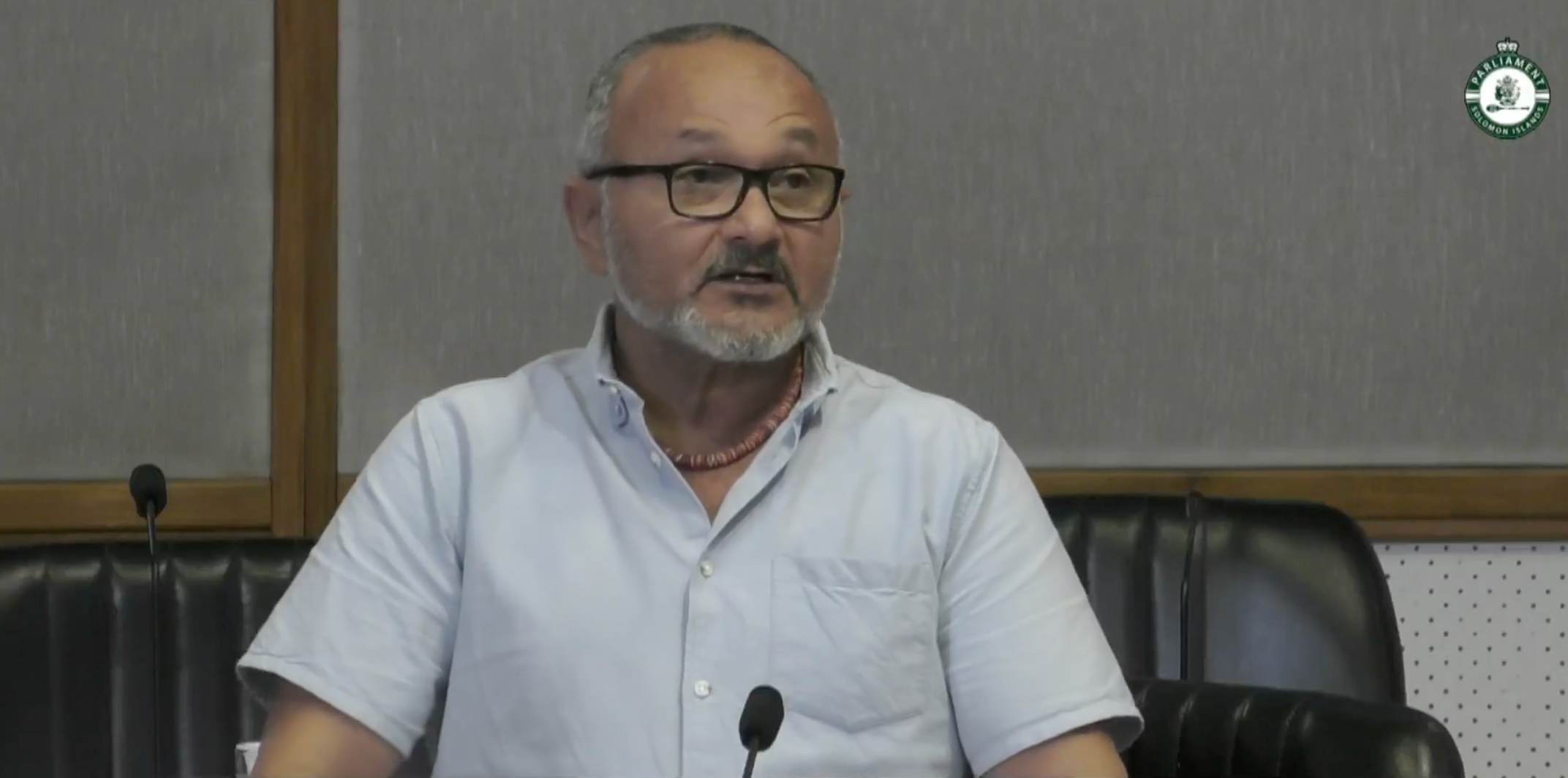
The mining sector has the potential to become a major pillar of Solomon Islands’ economy, so it must be guarded “jealously”, Opposition leader Matthew Wale says.
Speaking in Parliament, Wale said minerals are a non-renewable resource and must be treated as such in government policy and decision-making.
“Therefore, sustainability of income from this sector must guide policy on how to maximise and allocate income and wealth from this sector,” he said, adding that equitable and inclusive growth must be a core objective of any minerals policy.
Wale said Solomon Islands’ experience with the forestry sector should serve as a cautionary tale as mining activity expands.
He said decades of poor management in forestry had resulted in wealth being concentrated in the hands of a few individuals and foreign interests, while local communities saw limited long-term benefit.
“I keep saying, and it is worth repeating – the development of Solomon Islands is the development of Solomon Islanders.
“The mismanagement of the forestry sector demonstrated many things that must never be repeated.
“It is a terrible thing that the income and wealth from the forestry sector are concentrated in the hands of a very few, and foreigners.
“This cannot be development; and it is certainly not what we want to see in the minerals sector.
“We need to guard the minerals sector jealously.”
The Ministry of Mine and Energy’s Online Repository shows there are currently 36 active mining licences being issued – 36 prospecting licences and eight mining leases.
It’s understood there were four active mining operations.
1. Gold Ridge Mining Ltd on Guadalcanal
2. Pacific Nickel Mining Ltd – developer of the Kolosori Nickel Project on Isabel
3. Solomon Islands Resources Company Ltd — operator at the Suma mining site on Isabel
4. Solomon Nickel Mining Company Limited (SNMCL) – Operator of Siruka mine in Choiseul
All companies are foreign-owned.
Wale has stressed that mining, if managed properly, could deliver sustained government revenue, jobs, infrastructure development and broader economic diversification – but warned that repeating past mistakes would undermine those gains.
Wale also welcomed the government’s decision to abandon a proposal in the Mineral Resources Bill 2025 that would have reduced direct government involvement in the sector, describing the earlier approach as “misguided”.
He said the state must play an active role in mining — not only as a regulator but also as a commercial participant — to ensure environmentally responsible practices and long-term revenue security.
“Government must be involved at the commercial level, the prudential level and the regulatory level,” he said.
Wale called for the urgent establishment of one or two state-owned enterprises (SOEs) to lead government participation in prospecting and to hold mining leases in large mineral deposit tenements.
He said such an approach would help ensure greater national control over strategic resources and maximise returns for Solomon Islanders.
The Opposition Leader also welcomed the government’s announcement that it would establish a Sovereign Wealth Fund, describing the move as long overdue.
However, he cautioned that the fund must be designed to benefit future generations and not be used as a short-term solution to government cash-flow pressures.
“It must not be used as a backstop for government cash-flow requirements, as this would defeat the purpose of a Sovereign Wealth Fund,” Wale said.
He urged the Ministry of Finance to study successful sovereign wealth funds in other resource-rich countries to ensure Solomon Islands adopts best practice as mining revenues begin to grow.
