
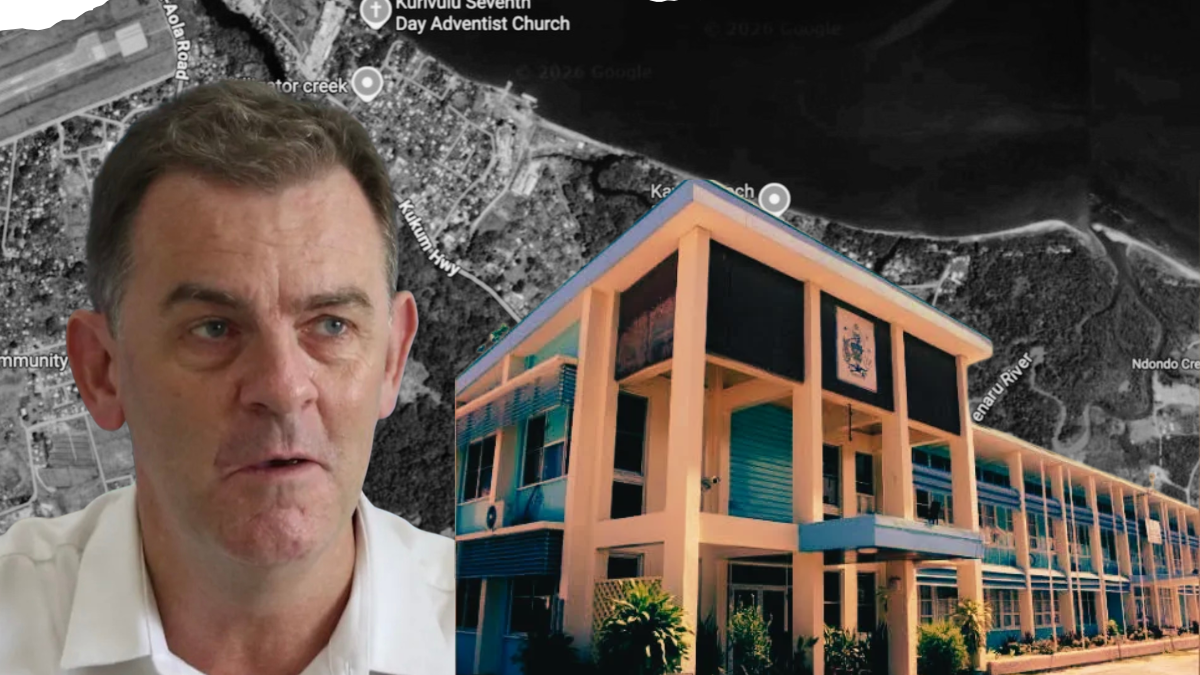
by Ednal Palmer
The Solomon Islands Government is facing questions over its approach to the controversial Levers land dispute, particularly why it is proceeding with an arrangement to acquire 121 hectares at Hells Point for approximately SBD$65 million when a separate court-backed pathway could potentially give it greater shares in Levers Solomon Limited (LSL).
The question has been raised by former Commissioner of Lands Alan McNeil, who argues that the recently signed Consent Orders concerning Hells Point should not be confused with the broader acquisition of Levers’ land interests across Guadalcanal and the Russell Islands.

McNeil told In-depth Solomons that the Government is not choosing between buying Levers for SBD 65million or $140 million, as some members of the public have been led to believe.
He says the SBD$65 million arrangement relates specifically to the acquisition of 121 hectares at Hells Point, representing only approximately 1.4 per cent of the total land area covered by Levers’ Fixed Term Estates (FTEs).
“This means the Hells Point settlement, if completed, would secure only a small fraction of the wider land interests associated with Levers.
“The bigger issue is why the Government appears to be pursuing this limited arrangement instead of a separate legal mechanism that could potentially deliver control over a substantially larger portion of the company’s land interests”.
A court-backed pathway that could change the outcome
At the centre of McNeil’s argument is a High Court ruling concerning a proposed Deed of Company Arrangement (DOCA).
He explained that the High Court ordered that the Government has a binding agreement to enter into a DOCA to acquire companies associated with 75.1 per cent of Levers.

The remaining 24.9 per cent is owned by Lavukal.
Under the proposed arrangement, McNeill said the Government would take over the directorship and shares associated with Patrick Wong, potentially giving it control of the companies holding the majority interest in Levers.
He believes this pathway offers the Government an opportunity to secure control of the wider Levers land interests rather than limiting its acquisition to the Hells Point property.
McNeil further argued that following the Attorney-General’s decision to close the door on appeals concerning the High Court ruling on compulsory acquisition and forfeiture, the DOCA represents the best available route for the Government to pursue control of Levers.
However, he questioned why the Government was not taking this option.
“If the Government has a court-backed pathway to acquire companies holding 75.1 per cent of Levers, why is it pursuing an arrangement that covers only 121 hectares?” is the central question arising from McNeil’s explanation.
“The people of Guadalcanal don’t benefit from this arrangement”.
McNeil also raised concerns about the Hells Point settlement’s implications for the future ownership and disposal of the remaining Levers land interests.
He argued the SBD$65 million payment could let Levers receive money for the Hells Point property while retaining the opportunity to sell other land interests.
He claimed the Ministry of Lands is now allowing Levers to sell its land to foreign buyers and powerful individuals.
“The reality is that the Ministry of Lands is now allowing Levers to sell its land to foreigners and powerful people,” McNeill said.
He suggested that this could undermine the broader objective of securing the land for the Government and the people of the Solomon Islands.
McNeil also questioned Patrick Wong’s position regarding the proposed DOCA.
He claimed Wong does not want the Government to proceed with the arrangement, despite the fact that he would receive what is owed to him as a secured creditor of the companies under administration.
McNeil believes Wong could potentially benefit financially from the Hells Point arrangement while retaining the opportunity to sell other Levers land interests.
He said, “Where is the justice for the people of Guadalcanal”?
The Government’s decision requires public explanation
The Levers dispute is not simply about the price of a piece of land. It concerns the Government’s broader approach to land ownership, corporate control, court decisions and the long-term interests of Solomon Islanders.

The distinction between the two arrangements is particularly important.
The Hells Point Consent Orders concern 121 hectares for approximately SBD$65 million. The proposed DOCA, on the other hand, concerns the acquisition of companies associated with 75.1 per cent of Levers, potentially providing a much broader route to control of its land interests.
These are fundamentally different legal and commercial arrangements and should not be presented as two alternative purchase prices for the same acquisition.
He said the Government therefore needs to explain why it is pursuing the Hells Point settlement, what it intends to do about the proposed DOCA, and whether it has considered the long-term implications of allowing the remaining Levers land to be sold.
He said there also needs to be clarification… from the government as to whether it still wishes to pursue the DOCA, and if so, why it is allowing Levers in the meantime to sell its land titles, thereby diminishing the value of that deal.
“The concern is that the Government could secure only a small portion of the Levers land through the Hells Point arrangement while a potentially wider acquisition pathway remains unpursued.
Ultimately, the public deserves clarity on the Government’s strategy. “Where is the justice for the people of Guadalcanal?”
“Why settle for 121 hectares when a separate court-backed arrangement could potentially secure control of companies holding a substantially larger portion of Levers’ land interests?”
