
by Ednal Palmer
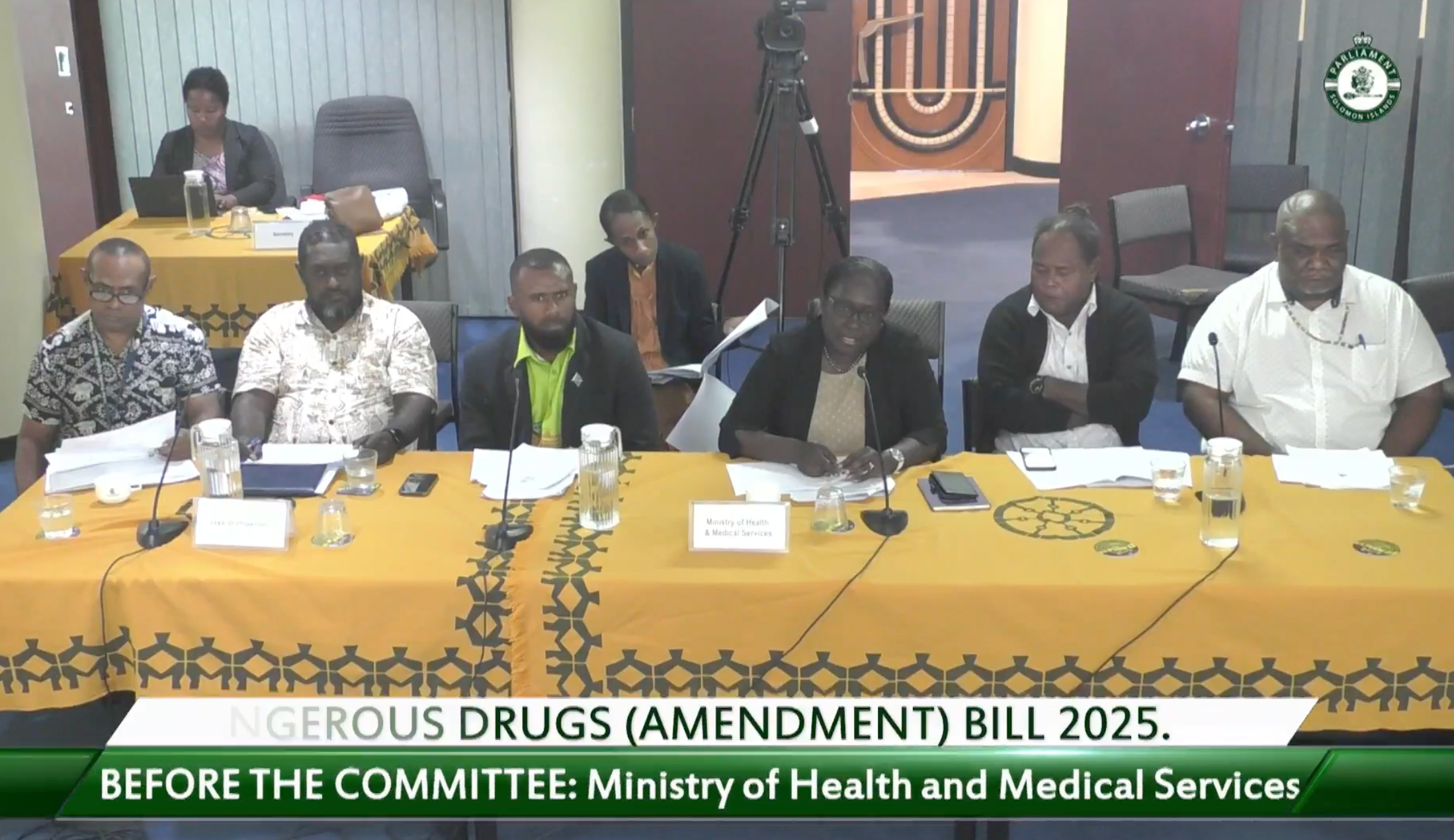
The Ministry of Health and Medical Services (MHMS) has defended proposed amendments to the Dangerous Drugs Act, citing a sharp rise in methamphetamine-related incidents and warning of growing pressure on the country’s health system.
Appearing before a hearing into the Dangerous Drugs (Amendment) Bill 2025, MHMS Permanent Secretary Pauline McNeill said the current law is “outdated and no longer fit for purpose”.
“What has triggered this situation is that we have an outdated Act; therefore, we have to update it,” McNeill told the hearing, pointing to recent reports of meth interceptions through yachts, postal services, local sales, and even domestic manufacturing.
She said the urgency behind the amendments is driven by the scale and sophistication of the illicit trade, prompting the government to consider significantly tougher penalties.
As of November last year, the Minister of Health introduced and gazetted a new regulation making it illegal to produce, manufacture, distribute, or possess methamphetamine in the country.
According to McNeill, the Dangerous Drugs Act has never undergone a comprehensive review.
“With the new rule and the passing of the amendment, the legislation would finally be current,” she said.

Health System Under Threat
MHMS argues that tougher penalties are justified because of meth’s long-term social, financial, and mental health consequences.
“The effects of meth will have huge financial and mental implications and place immense pressure on health services and infrastructure,” McNeill said, adding that the drug trade is highly lucrative.
“With costs being pushed onto the health system, it is only right that increased penalties are imposed.”
She also noted improvements in enforcement capacity.
While the country could not previously test for illicit drugs, the pharmacy division is now equipped to do so. Tests can detect drug residue on a person, personal belongings, or through urine within five minutes.
Plans are also underway to establish a mini laboratory to strengthen testing capability.
Calls for Evidence
However, Public Accounts Committee (PAC) outspoken member Mathew Wale (MP) pressed MHMS on the lack of concrete data to support the scale of the problem.
The CEO of National Referral Hospital (NRH), George Malefoasi acknowledged that monitoring and surveillance remain a challenge.
A 2024 mental health report recorded 54 drug-related cases, but it did not specify which substances were involved due to previous testing limitations.
MP Wale challenged officials to provide stronger evidence.
He demanded clarity on the size of the meth problem, where it is most prevalent, and whether proposed penalties – reportedly as high as SBD 15 million – would act as an effective deterrent.
“How do you know this level of penalty will stop it?” he asked.

Coordination Still Lacking
In response, McNeill said MHMS is re-engaging a technical adviser to develop a comprehensive drug control policy that would replace the existing Dangerous Drugs Act.
She revealed that a joint Cabinet paper was approved last year to establish a multi-agency task force involving customs, police, health, and immigration.
“Unfortunately, we have yet to convene our first meeting,” she admitted.
“At the moment, we are operating on an ad hoc basis. Once this is in place, we should be in a much stronger position to coordinate and improve information sharing.”
Debate Over Penalties
The hearing also exposed sharp divisions over how far the law should go.
Opposition Leader, Matthew Wale said he favoured the death penalty, arguing that the magnitude and seriousness of meth trafficking warranted the harshest possible response.
McNeill reiterated that the amendment was prompted by a steady increase in meth-related incidents since 2016.
She also highlighted suspected links between meth use and rising HIV cases, though she acknowledged that a direct relationship has yet to be scientifically established.
The Health permanent secretary said reported cases are most prevalent among young people in Honiara and Malaita, underscoring the urgency for legislative reform.
As the Bills and Legislations Committee continues its scrutiny of the bill, the debate is increasingly centred not just on tougher penalties, but on whether the government can back its crackdown with data, coordination, and sustained enforcement.

You must be logged in to post a comment.