
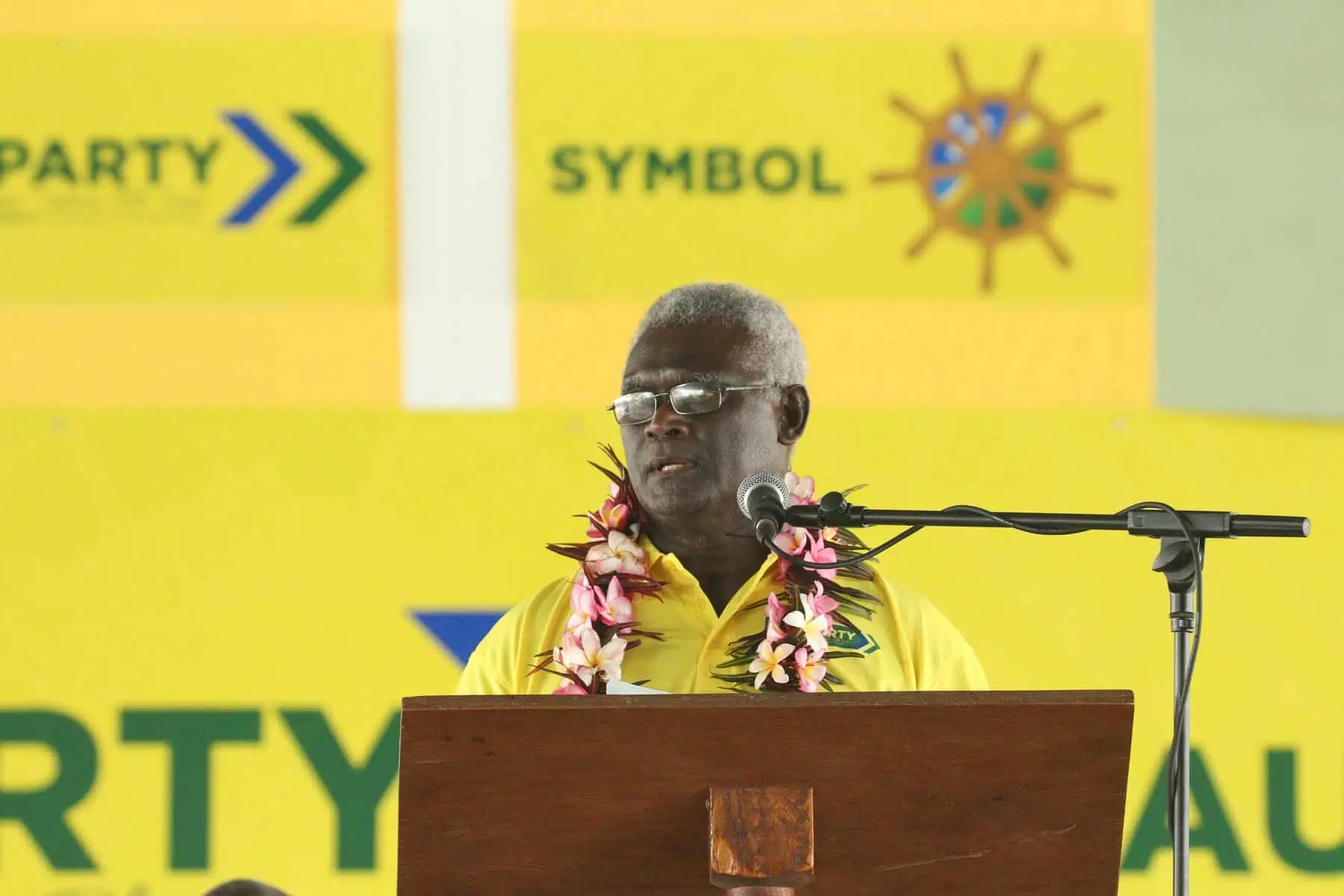
Solomon Islands Leader of the Official Opposition and former Prime Minister, Manasseh Sogavare has reaffirmed his support for accessible and affordable education for every child in Solomon Islands, while calling on the Government to clearly define what it means by its proposed “fee-free education” policy before asking the country to embrace a major new national commitment.
Mr Sogavare said the Government must first answer a number of basic but important questions.
He said Solomon Islanders deserve to know whether “free education” applies only to schools directly owned and administered by the Solomon Islands Government and provincial governments, or whether the policy is also intended to extend to church-run and other privately managed schools.
He added that the legal framework already distinguishes between government-funded schools and self-funded schools, and that this makes policy clarity even more important before any blanket public promise is made.
The former Prime Minister said the Government must also clarify whether “free education” means removal of school fees only, or whether it also includes boarding fees, food, utilities, dormitory costs, and other operational expenses.
“Before the country is asked to support a fee-free education policy, Government must tell Solomon Islanders exactly what is free, which schools are covered, and who will carry the cost,” Mr Sogavare said.
“There is a big difference between waiving tuition fees in government day schools and promising to cover boarding, accommodation, food, utilities and other operational costs across the system. Those are not the same policies, and they do not carry the same financial burden.”
The Opposition Leader further noted that the Education Regulations 2024 already set maximum school fees and prohibit schools from imposing extra fees or levies for enrolment, transfers, examinations or assessments.
“The present co-contribution model under the Education Act 2023 and Education Regulations 2024 places reasonable limits on school fees while still enabling schools to receive operational support from both government and parents,” he said.
“For example, the regulations cap annual fees for non-urban junior secondary day students at $800, while primary day school fees in rural areas are capped at $250 annually. These measures were specifically designed to protect families from excessive charges while maintaining shared responsibility.”
He said the same legal framework also makes clear that there are some costs that still sit outside school fees, including uniforms, transport, excursions, extracurricular activities and other student consumables.
“If Government is now promising ‘free education’, it must be honest with the public about whether those costs remain with parents or whether taxpayers are also expected to carry them. A serious policy cannot be built on slogans alone.”
Commenting on indications that the new administration intends to pursue the policy through a supplementary budget process, Sogavare said the Government must first confront the demographic, financial and institutional realities facing Solomon Islands before making major national spending commitments.
“With an average of approximately 46 births recorded every day in Solomon Islands, our country is effectively adding the equivalent of a new classroom of children every 24 hours,” Sogavare said.
“That translates to more than 16,000 additional children every year entering the education system. Any government serious about expanding fee relief must also explain how it intends to finance the classrooms, teachers, learning materials, dormitories and infrastructure required to support that rapidly growing population.”
Mr Sogavare said free education must never be discussed separately from quality education.
“It is one thing to promise free education. It is another thing to deliver quality education,” he said.
“If classrooms are overcrowded, teachers are overstretched, grants are delayed, and learning materials are missing, then the public will quickly discover that a fee-free promise alone is not enough. Families want affordability, but they also want quality and relevance in the education their children receive.”
The Opposition Leader also emphasised that education in Solomon Islands has always been a shared partnership involving families, churches, communities and the state, and said any reform must preserve that shared sense of responsibility.
“Parents must continue to play an active role in their children’s education. That sense of shared ownership is important for accountability, discipline and long-term community support for our schools,” Sogavare said.
Sogavare also noted that the current regulations already require arrangements to support families facing financial hardship, including payment by instalments, labour or materials in some cases, and fee remission in appropriate cases for primary and junior secondary students.
The first responsibility of Government should be to enforce the law properly, strengthen hardship support, and improve school quality before rushing into a broad national promise that may later prove difficult to sustain, he said.
“We all want accessible and affordable education for our children.”
“But policies of this scale must be clearly defined, carefully planned, financially sustainable, and capable of protecting the quality of education. The priority must always be securing the future of our children, not making promises that may later prove difficult to deliver.”
[ENDS]
