
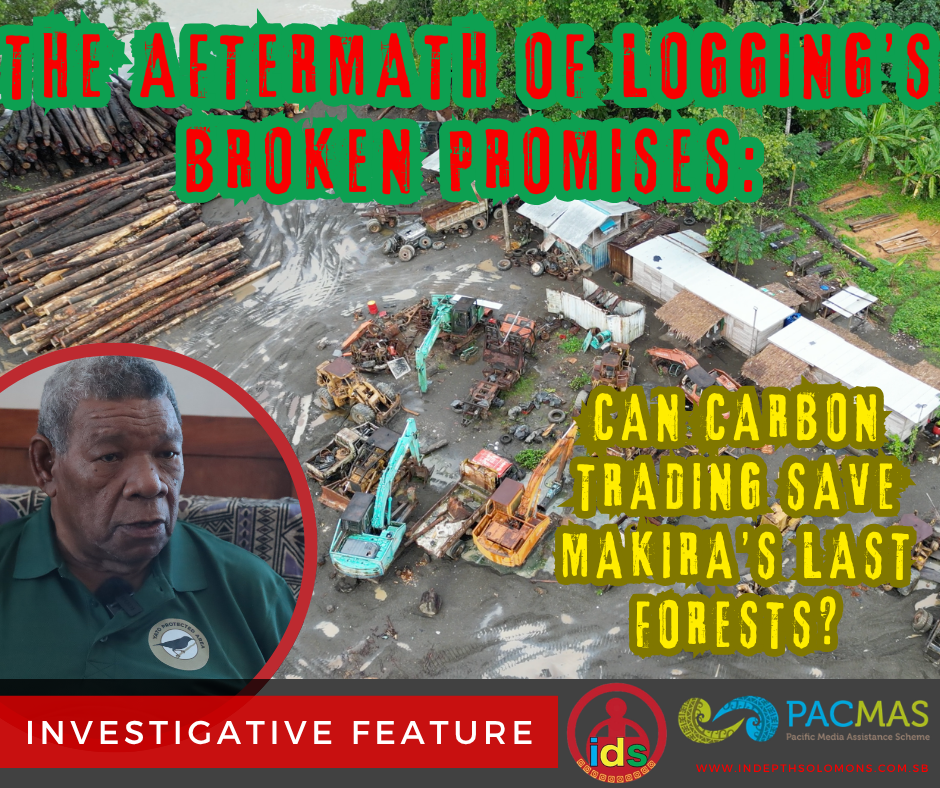
by Georgina Maka’a & Ronald Toito’ona
Once called Solomon Islands’ least developed province, the logging industry was sold as the catalyst for change for Makira-Ulawa province.
Instead, with 75% of loggable trees already harvested, the industry has left a legacy of unfulfilled promises.
For decades, Makira-Ulawa has been forgotten by developers, except for those looking to extract its timber.
Today, the graveyards of rusty machinery left behind by loggers now become monuments to unfulfilled promises.
A recent visit to the Bauro region of Makira Island by In-depth Solomons uncovered a grim reality.
While the logs are nearly gone, the promised clinics, schools, churches and prosperity never arrived.
As the province faces total forest depletion, this special report uncovers the permanent impacts on village life and the new hope found in carbon trading.

What’s Left? Nothing
When the logging machines fall silent and the foreign workers depart, what remains for the people of Bauro in Central Makira is one big question.
For Dominic Taro, a 73-year-old elder from Manihuki Village in central Bauro, the answer is heartbreaking.
“There’s nothing left behind. Nothing,” Taro told In-depth Solomons.
Taro has seen six different companies operate in his area since the 1980s.
“I have not seen any changes logging brought to our communities. They have not helped us to build clinics, schools, or facilities,” he added.
He told In-depth Solomons that the math of logging rarely favors the local land owners or even the villagers.
While millions of dollars in timber leave the shores, Taro recalls the highest royalty share he ever received was a mere SBD$1,000.
At the time, this amount was not enough to build a permanent home, let alone starting a small income generating business.

Rosina Aramo of Kaonasugu echoes this, noting that in 2018, a company promised to rebuild a local church in her community.
“Today, years after they left, not a single nail has been driven,” she said.

Nigel Usumae, a local farmer, said logging companies have promised to do water supply, building schools and clinics, but nothing has happened.
“I think they are promising these things as part of negotiation to enter into the areas,” said Usumae, who returned to Makira in the early 2000s after spending his younger days in Honiara.

However, logging has both good and bad impacts. It all depends on how trustees come up with ideas to use the royalties to generate sustainable activities.
These were the words of Julie Kabea, a landowner trustee of one of the tribes in Central Makira, who uses logging royalty to purchase a vehicle that provides transportation to generate income for people in her tribe and ensure her tribe has timber to build better homes for their families.
“For our group as a trustee, management is important. One positive impact that logging has had on our communities, especially our tribe, is that we make sure logs are milled so families can build their permanent homes.”
“Like for my tribe, we invest our royalty to purchase a vehicle to provide transportation so we can have money for our people in need,” Kabea says.

Life Before and After
Logging in Solomon Islands has depleted the forests.
Even if some trees remain, it’s the secondary trees that are now being logged, Central Bank of Solomon Islands (CBSI) Governor Dr Luke Forau told local media in a recent press conference.
He says there are no longer any virgin forests left, so most loggers are now moving into the mining sector.
However, Forau says logging still remains in the top two in terms of foreign exchange coming into the country.
Forau adds that now mining is picking up, the governance around it needs to be strengthened so it does not go the same way as logging.

There were a lot of issues encountered, and the government didn’t really benefit in terms of economic return from the forestry sector.
“We would have benefited more had we managed the sector well.”
Before logging arrived, communities lived off the land and sea in a delicate balance. When logging enters, there is a brief, artificial surge of cash.
Christopher Marenga, from Hao Village, calls it “money shock”.
“For some, it was their first time to see huge sums of money. They misused it, thinking logging would stay forever,” Marenga explains.
But the ‘after’ is a bitter pill to swallow, he said with a laugh.
“When the companies left, they were dropping back to ground zero. Some even to -10.”

He added those who didn’t invest their royalties in small businesses like cocoa or copra now find themselves without money and without the forest resources they once relied on.
“The garden lands that once sustained them are no longer productive due to topsoil erosion and climate-driven changes in the soil,” Marenga said.
The physical destruction of the land has turned daily survival into a struggle for mothers and farmers.
The once-clear streams and fertile gardens have been replaced by silt and rusted machinery.

Human Trafficking and Cultural Decay
Perhaps the most sensitive and under-reported impact is the social cost to the province’s youth.
Chief Robert Ngiriapu of the Manihuki community speaks candidly about an old issue that continues to haunt the industry – the exploitation of young girls.
“Our youths today, especially girls, were influenced… where girls want to marry Asians, I think because of the money,” Chief Ngiriapu observes.
He notes that these arrangements often break custom and cause deep divisions within families.

“This is about the systemic luring of vulnerable people with small amounts of cash to stay silent about rights violations. This is not just about marriage,” the Chief said.
According to Ngiriapu, in some areas within the Bauro district, companies have had to implement strict ‘no contact’ rules to prevent these issues.
“But I have seen babies with mixed local and Asian parentage here. This indicates that the rules often come too late,” Chris said.
Environmental Ruin: A Mother’s Toll
While men often dominate the logging negotiations, women like Rosina Aramo bear the daily struggle of the aftermath.
“Logging is not good because it spoils our land,” Aramo says.
“It spoils the ground, causes landslides, and spoils the water sources. We end up drinking dirty water.”
In Makira, women are the resource owners because of the matrilineal system practised there.
Joyce Murray, one of the resource owners of Star Harbour, says that when it comes to signing off on logging agreements or royalties, you hardly see women taking the lead.

For those living in low-lying coastal areas, this is compounded by the loss of biodiversity and the destruction of mangroves, which once protected the shore from rising tides.
“I did not favor logging. Instead of making us good, it is total destruction. Experiences like flooded rivers and streams, I think logging is not the best thing for the country,” Kaonasugu resident, Usumae added.
Carbon Trading: A New Phenomenon for a Sustainable Future?
With Premier Stanley Siapu estimating that 75% of the province’s loggable trees already gone, the province is at the crossroads.
The Premier is now pushing for a drastic shift toward reforestation and conservation.
“Logging leaves you with nothing, but conservation protects our future,” Siapu says, pointing to the success of the Yato Protected Area, which was officially launched in Kirakira, on Friday 27th March 2026.

A new hope is emerging in the form of carbon trading.
This scheme, spearheaded by NGOs, allows communities to receive income for not cutting down their trees.
Usumae told In-depth Solomons that he believes this is the breakthrough Makira needs.
“Carbon trading is the best thing. You take money but you also preserve your forest. You benefit but don’t destroy your areas,” Usumae says.
Murray agrees!
She believed carbon trading is the way forward for women because “it’s a community thing where everyone will benefit.”

However, while resource owners think this is the way forward for forest conservation in Makira, Deputy Commissioner of Forests Gideon Solo, who is also the Head of Forest Management and Technical Division, says there is still a long way to go.
“…..this is in terms of making sure that relevant policies, regulations and legislative frameworks are in place to strengthen what we are doing (Carbon Trading). I think that is the direction.
“At the same time, at the provincial level too. We must work together to ensure that there are right ordinances to help support the work,” Solo told In-depth Solomons.
* This story was produced with funding support from PACMAS (Pacific Media Assistance Scheme), an Australian Government aid program designed to strengthen and support a diverse, independent, and professional media sector across the Pacific.

You must be logged in to post a comment.